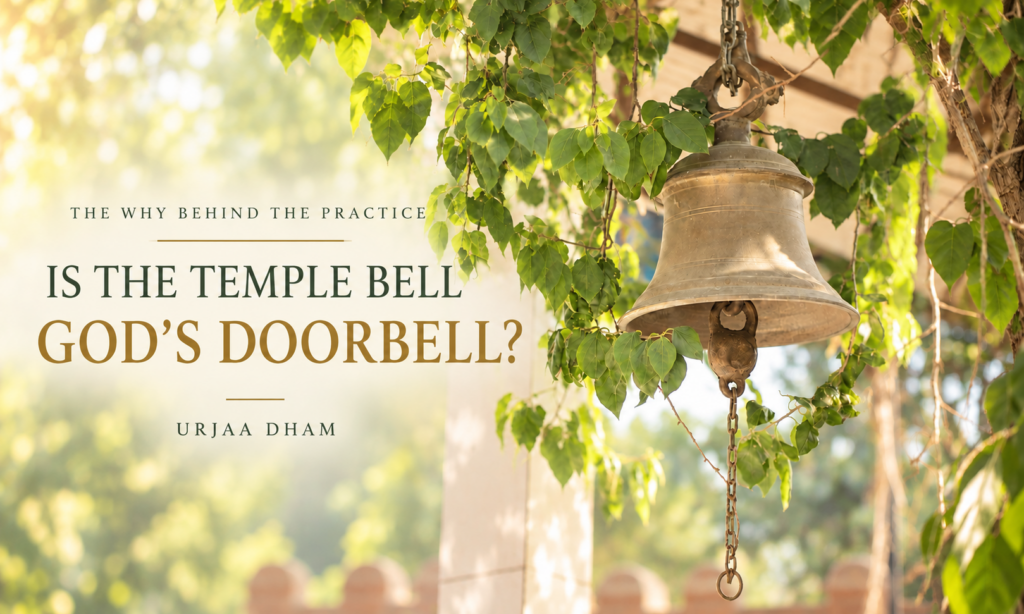
If God already knows we have arrived, why do we ring the Ghanta before Darshan?
Most of us have followed the same practice since childhood: remove our footwear, enter the temple, ring the Ghanta and proceed towards the Garbh-griha.
When asked why, we often hear:
“We ring the bell to inform God that we have arrived.”
But does God really need to be informed? Was the Divine unaware of us before the bell rang?
The Ghanta is not God’s doorbell. It is meant to awaken and prepare the person entering the temple.
Your Body Enters, but Has Your Mind Arrived?
Our feet may enter the temple while our mind remains outside; occupied with work, family concerns, mobile notifications, past disagreements or future worries.
The sound of the Ghanta interrupts this continuous flow of thoughts. It brings our attention back to the present moment and prepares us to enter the sacred space consciously.
God already knows that we are there.
The bell asks us: Are you truly here?
A Traditional Ghanta Is Carefully Designed
In a traditionally established temple, the Ghanta placed near the Garbh-griha is not merely decorative. Its metal composition, shape, dimensions, weight and placement determine the quality of its resonance.
Not every modern metal bell can create the same effect. A bell may make a loud sound yet fail to produce the clear, sustained vibration expected from a properly designed Ghanta.
When struck correctly, its sound spreads through the surrounding space and may also be felt through the body.
Science recognises that sound is produced by vibration and that living cells and tissues respond to physical and mechanical influences. Traditional temple science carries this understanding into a subtler energetic dimension. It views the human body as a receptive structure capable of interacting with sound, sacred space and the Earth.
The bell is therefore not meant merely to be heard.
It is meant to be experienced.
How Should the Ghanta Be Rung?
At Urjaa Dham, we often see devotees ring the Ghanta and immediately rush towards the Garbh-griha; as if a train is about to leave or someone else will take their turn of Darshan.
The ritual is performed, but the experience is missed.
The Ghanta should be struck only once, using a measured and controlled stroke. The stroke should produce a clear resonance lasting approximately 10–15 seconds.
It should not be hit repeatedly or with unnecessary force. Greater force may increase the loudness, but it does not improve the bell’s natural resonant quality.
After striking the Ghanta, stand directly beneath its centre. Remain still as the strong initial sound gradually becomes softer and subtler before finally dissolving into silence.
A person sensitive to loud sounds may use a gentler stroke. The purpose is not to create the loudest sound. The purpose is to receive the resonance comfortably and consciously.
Every devotee should ring the Ghanta individually because this is an act of personal preparation. One person cannot breathe, meditate or grow on behalf of another. In the same way, another person’s ringing cannot completely replace your own conscious participation.
One bell. One measured stroke. One complete experience.
Receive, Release and Become Grounded
Within the traditional subtle-energy understanding, vibrations are received through the head, hair and upper body. They then pass through the body towards the feet.
This offers a deeper explanation for entering a temple barefoot.
Cleanliness and respect are important reasons for leaving footwear outside. But removing footwear also brings the feet into more direct contact with the temple floor and the Earth below.
The Ghanta resonates. The body receives. The unbalanced is released. The Earth grounds.
At Urjaa Dham, negative energy is not automatically considered bad or evil. Positive and negative are both parts of existence. Either can become harmful when it is excessive, unwanted or unbalanced.
During the Ghanta experience, disturbed and unbalanced currents are understood to move downwards through the feet and return towards their natural ground.
The purpose is not to fight negativity.
The purpose is to restore balance.
Properly tied or appropriately covered hair does not prevent the reception of vibration. Within Urjaa Dham’s understanding, disciplined hair creates greater uniformity in receiving it. Receptivity does not require disorder.
Does the Ghanta Heal the Body?
The metal bell itself should not be treated as a magical cure. The principle lies in the body’s interaction with the vibration generated by a properly designed Ghanta.
Living cells exist in continuous motion and respond to physical influences. Traditional temple science proposes that orderly resonance can support greater physical and energetic alignment.
This may be understood simply as:
Balanced vibration supports a balanced body; and a balanced body supports a healthier state of mind.
This is a traditional energetic interpretation, not a replacement for medical diagnosis or treatment.
The Bell Also Energises the Temple
The Ghanta does not interact only with the devotee. Its resonance also spreads through the Garbh-griha, its walls, floor, Murti and surrounding space.
When a properly designed Ghanta is rung consciously by generations of devotees, its repeated resonance becomes part of the living spiritual field of that temple.
The Ghanta is not the only contributor. Pran Pratishtha, Mantra, Aarti, meditation, rituals, Sankalp, offerings and the collective Bhava of devotees all nourish a sacred place.
This may help explain why certain ancient temples feel unusually intense, peaceful, magnetic or “heavy” the moment we enter them.
Heavy vibration does not necessarily mean something negative. It may indicate a spiritually concentrated atmosphere that has been sustained through generations of worship and disciplined participation.
The temple influences the devotee, and the devotee’s conscious participation also contributes to the temple.
The bell awakens something within the seeker, while the seeker’s ringing helps keep the sacred space active.
Why Does the Priest Ring a Smaller Bell During Aarti?
The smaller bell used during Aarti serves a different purpose from the large Ghanta at the entrance.
The entrance Ghanta prepares each devotee for Darshan. The smaller ritual bell helps the priest remain fully attentive during Aarti.
A priest is also a human being with a physical body and an active mind. During Aarti, the flame engages the eyes while the rhythm of the bell engages hearing and movement. Together, fire and sound help the priest remain concentrated throughout the ritual.
The bell is not rung because the Deity needs to be awakened.
It supports the concentration of the human being performing the sacred act.
Sacred Sound Is Found Across Traditions
The use of sacred sound is not limited to Hindu temples.
Churches ring bells to call people towards worship and mark sacred time. Buddhist monasteries use bells, gongs and chants during meditation and monastic practices. Singing bowls have also become popular in modern meditation and wellness sessions.
People now pay to sit quietly while the sound of a singing bowl moves through the room. They remain still, listen carefully and allow its vibration to fade.
Yet a related opportunity has long been freely available at the entrance of traditional temples.
These instruments belong to different traditions and do not necessarily have identical meanings. However, they reveal a shared human understanding: resonant sound can interrupt mental noise, gather attention and prepare us to enter a deeper inner state.
The Ghanta is still present.
What we have gradually lost is the patience to receive it.
Why Is the Entrance Ghanta Meant for Human Darshan?
Human beings live through a physical body and a conscious, continuously active mind. Our body needs food, water, breath, movement and rest. Our mind needs attention, meditation, discipline and silence.
That is why temple practices engage our physical senses.
We see the Murti. We smell the Dhoop and flowers. We touch the sacred floor. We taste Charanamrit or Prasad. We hear the Mantra, Shankh and Ghanta.
Other subtle or non-physical forms of existence are traditionally understood to interact with energy differently. They do not require a metal bell to prepare a physical body in the same way that an embodied human being does.
Therefore, the entrance Ghanta is associated with human Darshan; not because God becomes available after hearing it, but because the human visitor needs to become ready.
So, Is the Temple Bell God’s Doorbell?
No.
God does not need to be awakened. God does not need to be called from another room. God does not need to be told that we have arrived.
The Ghanta exists because we need to arrive completely.
It is a point of connection among the human body, the sacred field and the Earth. It prepares us to receive, helps us release what is unbalanced and allows us to participate in keeping the temple energetically active.
God does not sleep when the temple doors close, and God does not awaken when the bell rings.
The doors and the Ghanta belong to human discipline; not Divine limitation.
The Ghanta does not tell God, “I am here.” It reminds the seeker: “Be here.”
The Why Behind the Practice
Ring. Remain. Receive. Release. Then proceed for Darshan.
This article brings together observable properties of sound, traditional temple understanding and Urjaa’s interpretation of subtle-energy exchange. It invites observation and experience rather than demanding belief.
Observe • Experience • Understand
Stay Urjaavaan.